Keeping the Bots Out: How CAPTCHAs Help Protect Your Website

We've all encountered a CAPTCHA while visiting a website. We've had to check a box confirming we’re human, solve a puzzle, or wait a few seconds for a page to load while a security tool confirms our IP behind the scenes.
While these extra security steps can sometimes be frustrating, they're becoming an increasingly common part of browsing the web. As automated bots and malicious traffic continue to grow, website owners and hosting providers need additional layers of protection to keep servers secure, prevent abuse, and ensure websites remain accessible to legitimate visitors.
At Reclaim Hosting, we occasionally hear from customers who encounter these challenges when accessing their websites or logging into their hosting accounts. While we understand this can be an inconvenience, especially when trying to access your own website, they're an important part of keeping our servers secure and running smoothly.
In this post, we’ll take a closer look at why these challenges appear, what they're protecting against, and how we use them at Reclaim Hosting.
The Bots Are Everywhere!
Not all website traffic comes from people. A significant amount of activity across the internet is generated by automated programs, commonly referred to as bots.
Some of these bots are legitimate. Search engines use them to crawl and index websites, helping people discover content through search results. Other automated services monitor websites for uptime, check for broken links, or perform other useful tasks. Unfortunately, not all bots have good intentions.
Malicious bots can be programmed to scan websites for vulnerabilities, attempt to guess passwords, exploit outdated software, or overwhelm a server with automated requests. These activities can happen around the clock, often without website owners even realizing they're taking place.
Even when automated requests aren't explicitly malicious, a large volume of bot traffic can consume valuable server resources and affect website performance. This is where tools like CAPTCHAs come into play.
Why This Matters on Shared Hosting
At Reclaim Hosting, many of our customers use shared hosting environments. This means multiple websites are hosted on the same server, sharing resources such as CPU, memory, and network capacity.
Shared hosting is an affordable and flexible way to host websites, particularly for students, educators, and institutions. However, it also means excessive activity directed at one website can potentially affect other websites sharing that server.
As an example, let’s say one website on your account’s server starts receiving thousands of automated requests in a short period. Even if those requests don't successfully compromise anything, or if they’re legitimate requests with no ill intentions, the server still has to process them. When enough requests arrive at once, they can lead to increased server load, slower page speeds, or temporary availability issues.
Our goal in using the CAPTCHAs is to identify and filter out potentially harmful traffic before it can negatively affect the websites hosted on our infrastructure.
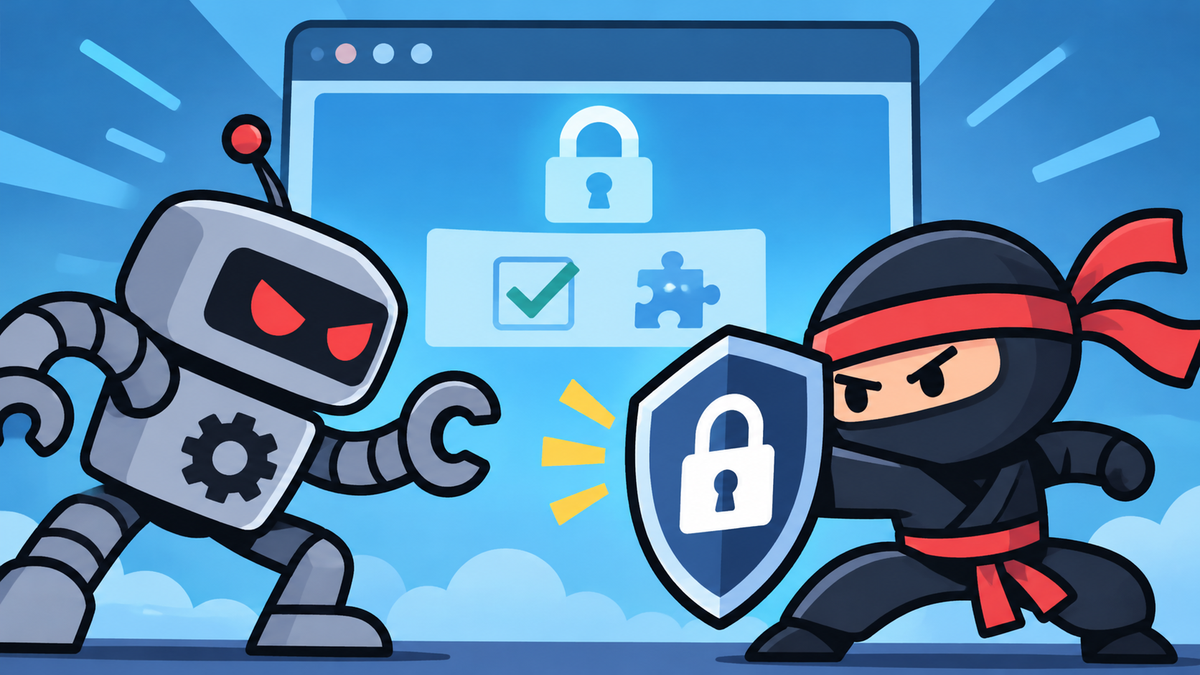
Ninjas vs. Bots
Reclaim Hosting uses BitNinja Security as part of our server-level security protections. BitNinja provides several security features designed to identify and mitigate suspicious activity, including firewall protection, malicious traffic detection, and automated challenges.
When traffic to a server matches certain patterns associated with suspicious behavior, BitNinja may present a CAPTCHA or another verification challenge before allowing the request to continue. This gives legitimate visitors an opportunity to verify that they're human while helping prevent potentially harmful automated traffic from reaching the website.
It's worth emphasizing that seeing a CAPTCHA doesn't mean you've done anything wrong or that your website has been compromised. An IP address you’re connecting from may have been associated with suspicious activity, your shared network may be generating unusual traffic, or certain requests may resemble patterns commonly used by automated tools, and this triggers the CAPTCHA verification.
These protections can be a little overzealous at times, resulting in legitimate visitors being challenged. Unfortunately, that’s a side effect of trying to distinguish between real visitors and the enormous amount of automated traffic constantly moving around the internet.
Balancing Security and Accessibility
One of the ongoing challenges of website security is finding the right balance between protecting websites and making them accessible. Ideally, security measures work quietly in the background, stopping malicious activity without interrupting legitimate visitors, but that isn't always possible.
While CAPTCHAs provide an additional layer of protection, we also realize that they can be frustrating, especially when they appear repeatedly or interfere with someone trying to access their own website. We're continually working to balance those competing needs as we want to keep our hosting infrastructure secure and reliable without introducing unnecessary obstacles for the people using it.
If you encounter a CAPTCHA while visiting your website, completing the challenge will usually allow you to continue browsing normally. But what happens when those challenges keep appearing?
Having Trouble with CAPTCHAs?
While CAPTCHAs are an important security measure, we understand that they can occasionally interfere with accessing or managing your website.
One issue we sometimes hear about is repeated CAPTCHA challenges. You might successfully complete a CAPTCHA when first accessing your website, but then you’ll encounter additional challenges as you navigate between pages or make edits on your site. If these challenges keep appearing and interrupting your workflow, that's something our support team can investigate.
On our Domain of One's Own environments, we are typically working directly with colleges, universities, and other organizations that may have students, faculty, or staff accessing their hosting environments from a common shared network.
If an institution's IP addresses are repeatedly triggering security challenges, we can review the situation and, when appropriate, add trusted IP addresses or ranges to an allowlist. This can help members of the institution access their websites and hosting accounts without unnecessary interruptions.
For customers using our shared hosting services, things are a little more complicated. Because the shared servers host websites for customers connecting from a wide variety of locations and networks, it's not always practical to allowlist large groups of IP addresses.
However, if you're regularly managing your website from the same IP address and repeatedly encountering CAPTCHAs, our support team can investigate whether your IP is being flagged by BitNinja. We can often unblock the address and, when appropriate, consider adding it to an allowlist to help prevent future interruptions.
Another issue that can sometimes occur is encountering a "Backend Server Unreachable" error after completing a CAPTCHA. This isn't expected behavior, and if you see this message, we encourage you to contact our support team so we can investigate what's happening and work toward a resolution.
A CAPTCHA Recap
CAPTCHAs are meant to protect your sites and keep things running smoothly, and they shouldn't prevent you from accessing or managing your website. If you're repeatedly encountering challenges, receiving unexpected errors after completing them, or otherwise having trouble accessing your site, please reach out to our support team. We're happy to investigate and help get things working as expected.