Support Systems: Customer Support Broke My Brain (And How To Fix It)

Customer support specialists deal in urgency on a daily basis. Even when we’re not dealing with truly urgent issues - like crashed networks, deleted accounts, or the dreaded white screen of death - other situations combine to add an underlying sense of pressing importance to every task. There are service level agreements demanding replies within specific time frames, and performance trackers lurk in the background, always watching, recording, and tallying how many replies we’ve sent, how quickly those replies go out and how many replies it takes to solve an issue.
Anyone who has worked in support for a meaningful amount of time knows there is a lot of context switching that happens throughout the day too. You jump from simple billing issues to complex technical troubleshooting. You spend fifteen or twenty minutes writing an in-depth reply to calm down a frustrated customer only to then knock out a simple, one-minute reply explaining where to update a DNS record.
Like most jobs, none of our daily tasks happen in a vacuum. You might get pulled into fixing urgent production problems during a time you had set aside to document a workflow process. You may be attending an internal meeting while replying to support tickets, or Slack alerts may be coming in about server issues while you try to troubleshoot a permissions error for a user. Regardless of the exact situation, we are frequently dealing with multiple tasks that each compete for our attention at the exact same time.
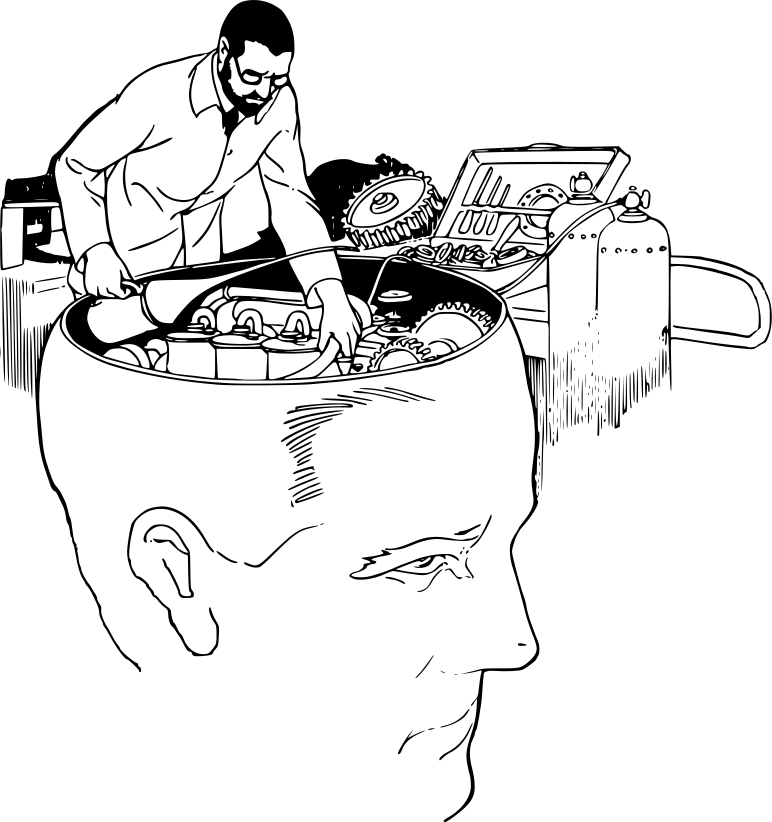
After enough years doing this kind of work, your brain adapts to it. The problem is that adaptation can make focused project work feel almost unnatural.
Support work rewards responsiveness, quick pivots, and the ability to rapidly absorb information from multiple directions at once. In many ways, it mirrors ADHD-style working patterns even for people who do not actually have ADHD. Your brain becomes optimized for urgency and handling constant incoming stimuli. There is always another notification, another ticket, another quick question, and another emergency.
You get very good at solving small problems quickly because that is what the environment demands from you, and solving those problems quickly provides a sense of accomplishment. Each situation handled is a gold star and an empty support queue feels worthy of recognition, or at least a screenshot in the Slack “watercooler” channel.
But then one day your manager says, “Can you spend the next two weeks focused on this larger strategic project?” And suddenly your brain feels broken.
It’s not because you can’t do the work and it’s not because you lack the skills, but because your entire working rhythm has been shaped around short bursts of reactive problem solving. That transition from reactive work to proactive work is harder than most people realize.
Support work creates a very specific type of momentum. Every completed ticket gives you a tiny sense of satisfaction, a little dopamine hit. You solved something! You helped someone! You closed the loop! The satisfaction is immediate and it is measurable.
Large projects don’t work like that. A long-term project might require hours of planning before you see visible progress. You may spend an entire afternoon researching, outlining, or troubleshooting something without the satisfaction of a resolved issue at the end. There is no ticket to close. No customer thanking you. No clear finish line for days or weeks. For someone conditioned by years of support work, that can feel mentally uncomfortable.
You sit down to focus on a project, and suddenly your brain starts craving interruptions. So, you check Slack or you pop into the support ticket queue to see if anyone needs help. You find some smaller tasks to complete because they provide faster gratification. This is not laziness; it is conditioning.
What makes it even more difficult is that customer support often rewards availability over concentration. If you answer quickly, you are viewed as responsive. If you jump into emergencies, you are viewed as dependable. If you are always active, always replying, that is enough to make you feel like you are succeeding.
Meanwhile, deep project work looks deceptively unproductive from the outside. Spending three uninterrupted hours writing documentation, building a new support process, or planning an outreach campaign can feel strange because there is no visible activity happening in real time.
Ironically, some of the highest-impact work in an organization requires the exact opposite mindset from support work. It requires protecting your attention instead of distributing it. That is a difficult habit to build when your professional identity has been shaped around being immediately helpful.
Support professionals become really skilled at handling fragmented attention, but many of us are very bad at transitioning out of that mode when deep focus is required. I notice this any time I move between support responsibilities and larger initiatives. One hour I might be troubleshooting account issues, answering questions, and juggling multiple conversations at once. Then I need to completely switch mental gears and spend focused time writing, planning, or building something long term.
Even spending the time focused on writing and editing this blog posts is challenging for me, and at this very moment I’m fighting the little voice in my head telling me to check Slack, check my email, take a two-minute break to get a drink and let the dog outside.
That transition from fragmented to deep work can feel exhausting in ways that are difficult to explain to people who have never worked in support. It’s hard to quantify because the issue is not the difficulty or the amount of work, but rather a change in your mental “mode.” The first places an emphasis on speed; the second values depth. One rewards rapid reaction; the other rewards sustained concentration. Having to move between those two modes repeatedly throughout the day or throughout the week creates a kind of mental friction that builds up over time.
So, the question becomes how do we deal with that friction? How do we overcome our addiction to urgency and commit to sustained periods of focused work? How do we go without our frequent little hits of dopamine and focus on the larger payoff that comes from completing larger and more complex tasks?
The interesting thing is that support work actually creates skills that are incredibly valuable for larger projects. Support professionals are usually exceptional at pattern recognition. We learn how to prioritize under pressure. We are skilled communicators because we spend our days translating technical problems into relatable language. These are important skills.
Leveraging these skills effectively, however, requires intentionally creating environments where focus can happen. For me, one of the hardest lessons has been realizing that focus and motivation are things that don’t magically happen just because I want them to. My brain has spent years adapting to interruptions, and so I have to actively work to rebuild my ability to work deeply.
That can mean simple things like blocking notifications for an hour, closing email completely, or sticking my phone in a drawer in another room. If your schedule allows it, working on projects early in the morning before support queues become active is helpful. Project tracking is immensely helpful. Being able to break large initiatives into smaller, completable milestones provides a much-needed sense of completion along the way.
Most importantly, it is important to understand that struggling to focus after years in support work does not mean you are incapable of deep work. It just means your brain became extremely good at a different kind of work, and that adaptability is something worth appreciating.
Customer support specialists operate in chaos every day. We absorb stress from multiple directions, process information rapidly, and keep things moving forward while constantly shifting priorities. That is a real skill set, and one you should value.
We also need to acknowledge, however, that this kind of work changes how you think. It shapes your attention span, your habits, your sense of productivity, and even your comfort level with silence and uninterrupted time.
So, if you struggle to transition into project work, strategy, or long-term planning, don’t beat yourself up because you lack discipline. Realize that you have spent years becoming an expert at the exact opposite mode of working. Learning how to slow down enough to focus deeply again can take just as much practice as learning support work did in the first place.